
Krav Maga vs BJJ — Which Is Better for Real-World Self-Defence?
Brazilian Jiu-Jitsu is a highly effective grappling art — but it was built for sport, and sport has rules that real life doesn't. Krav Maga is specifically designed for real-world self-defence, covering the full confrontation timeline: awareness, de-escalation, striking, grappling to avoid the ground, and rapid exit if you end up there. For self-defence as the primary goal, Krav Maga covers ground that BJJ simply doesn't.
The KMG New Zealand instructor team brings cross-training experience across combat disciplines including BJJ, and that background shapes how Krav Maga is taught — particularly around grappling principles, body mechanics, and ground responses.
A number of the KMG global instructor team are highly accomplished across combat disciplines including BJJ and MMA, and those influences help shape how KMG approaches movement, clinch work, and ground defence. But the emphasis stays strict: practical self-defence application comes first, not sport-first goals or prolonged ground engagement.
That experience also makes clear exactly where BJJ breaks down when the context shifts from sport to street. And those gaps are serious.
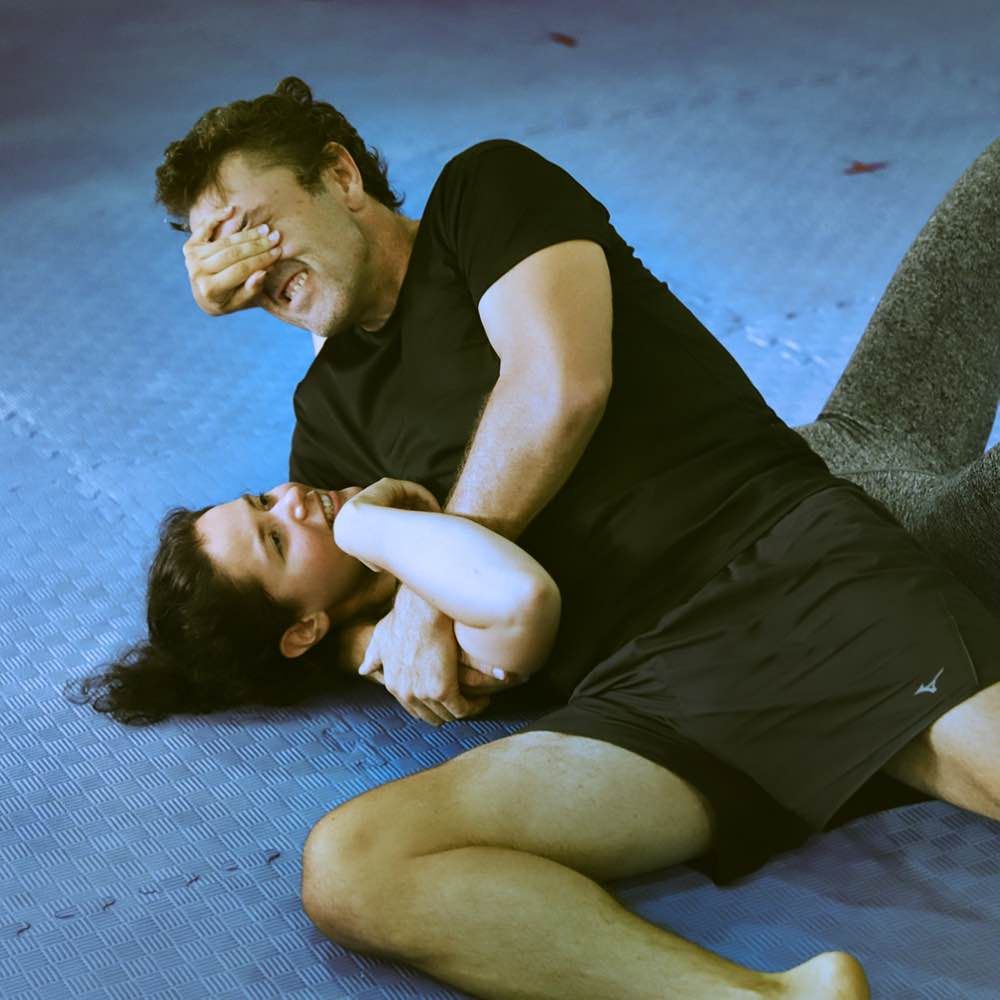
Standing defence training in a real-world self-defence context.
What BJJ Is Excellent At — and Why That Matters
BJJ deserves its reputation. It produces some of the most technically capable grapplers in the world, and the emphasis on live rolling — training against a genuinely resisting partner — means the skills get pressure-tested in a way that many traditional martial arts don't.
The grappling principles in BJJ are sound: body mechanics, positioning, leverage, and control. These transfer into Krav Maga training directly, and students who arrive with a BJJ background often have excellent foundations to build on. Good grappling awareness makes you harder to take down and better at managing the clinch — both valuable in any real situation.
The self-defence training timeline shows how these skills layer into a complete picture — grappling knowledge is part of the answer, not the whole of it.
Key takeaway: BJJ builds genuinely valuable grappling skills — the principles carry over directly into Krav Maga training and make you a more capable all-round practitioner.Why the Ground Is the Wrong Place to Be in a Street Situation
BJJ is a ground fighting art. Going to the ground in a real situation creates a set of serious problems that simply don't exist on the competition mat.
- The surface is hostile. Concrete, asphalt, gravel — the ground itself causes injury from impact alone.
- You tire fast. Ground fighting is exhausting. In sport, you have rounds and a referee. On the street, there's no bell.
- Other attackers. If you're focused on controlling one person on the ground, you are completely exposed to anyone else who's standing.
- Size and strength still matter significantly. BJJ's leverage principles help, but a substantially heavier person on top of you on concrete is a different problem than on a mat.
- Weapons become accessible. A person you're grappling with can still reach a pocket and draw a weapon.
- There's no tap-out. In sport, your opponent taps. On the street, that safety valve doesn't exist.
How Krav Maga Approaches the Ground Differently
Good Krav Maga training emphasises having useful skills across all stages of the confrontation timeline — not just one phase of it. That means:
- Prevention and awareness first — situational awareness, de-escalation, creating distance before a situation escalates.
- Good clinch and grappling skills to avoid being taken down, or to break free if a takedown is attempted.
- Breakfalls and rolls if you do end up on the ground — to absorb impact and avoid injury.
- Ground defence that accounts for standing attackers — protecting head and body while monitoring for additional threats.
- Getting up quickly as the primary goal — exit the ground as fast as possible and re-establish standing position.
In Krav Maga, the ground is somewhere to get off, not somewhere to fight from.
Key takeaway: Krav Maga trains the full confrontation timeline — avoiding the ground, protecting yourself if you end up there, and getting back up as quickly as possible."Enjoying all the realistic scenarios and practical defensive responses."
— Student feedback from practical Krav Maga trainingThe Legal Dimension — What Happens After
One question BJJ training doesn't address: what's the legal position if you choke someone unconscious in what you're claiming was self-defence? In New Zealand, the force used must be proportionate to the threat. Applying a submission to the point of serious injury in a street situation raises serious proportionality questions that a BJJ match never needs to consider.
The Krav Maga framework covers this explicitly — understanding the legal framework of self-defence is part of the broader conversation, not an afterthought.
Key takeaway: a self-defence framework needs to include the legal dimension as well as the physical one.So Which Is Better for Real-World Self-Defence?
If your primary goal is sport grappling, BJJ is one of the best systems in the world. If your primary goal is real-world self-defence, Krav Maga is the more complete answer because it deals with everything before, during, and after the physical exchange — not just the ground-fighting phase.
If you're comparing options more broadly, read Krav Maga vs MMA and Best Martial Art for Self-Defence.
Key takeaway: BJJ is excellent at what it does. Krav Maga is broader — and that breadth is what makes it more suitable for real-world self-defence.What People Ask About Krav Maga vs BJJ
BJJ has real value — its grappling principles are sound and training against a resisting partner builds genuine capability. The problem is what it doesn't cover: multiple attackers, weapons, hostile ground surfaces, the absence of a tap-out, and the legal consequences of applying submission techniques in a street context.
The ground surface causes real injury. You're completely exposed to any other standing attacker. Ground fighting is exhausting with no round timer. A person you're grappling with can access a weapon. And there's no tap-out. The goal in self-defence should be to avoid the ground and get back to your feet immediately if you end up there.
Yes — and your BJJ background will be a genuine asset. The grappling principles, body awareness, and comfort with contact all carry over directly. What Krav Maga adds is the real-world application layer: the complete confrontation timeline, weapons awareness, multiple-attacker scenarios, and the legal framework of self-defence that BJJ training doesn't cover.
Krav Maga teaches ground defence — which is different from ground fighting. The focus is on falling safely, protecting yourself, creating separation, accounting for other threats, and getting back to your feet quickly. The goal is not to stay on the ground and work toward submission.
The best next steps are Krav Maga vs MMA, Best Martial Art for Self-Defence, and What Is Krav Maga?.
Find Training Near You
Explore how Krav Maga works in practice and take the next step toward local training.
Find Training Near You