
Krav Maga vs Boxing: Which Is Better for Real-World Self-Defence?
KMG New Zealand trains Krav Maga for real-world self-defence, not sport competition. Boxing is an excellent combat discipline that builds striking power, timing, and defensive reflexes, but it operates inside a sporting framework that does not exist in real civilian violence. Krav Maga covers the wider reality: strikes, grabs, chokes, surprise attacks, multiple attackers, weapons, and the need to act lawfully and get out safely.
Boxing is one of the most battle-tested striking systems in the world, and many of its core mechanics show up across combat sports more broadly. Anyone comparing self-defence systems seriously should give boxing proper credit for what it does well.
But the question changes once the goal is not ring performance but everyday civilian self-defence. At that point, the important issue is no longer just whether a system can produce a good striker. It is whether the system prepares you for the way real threats actually happen.
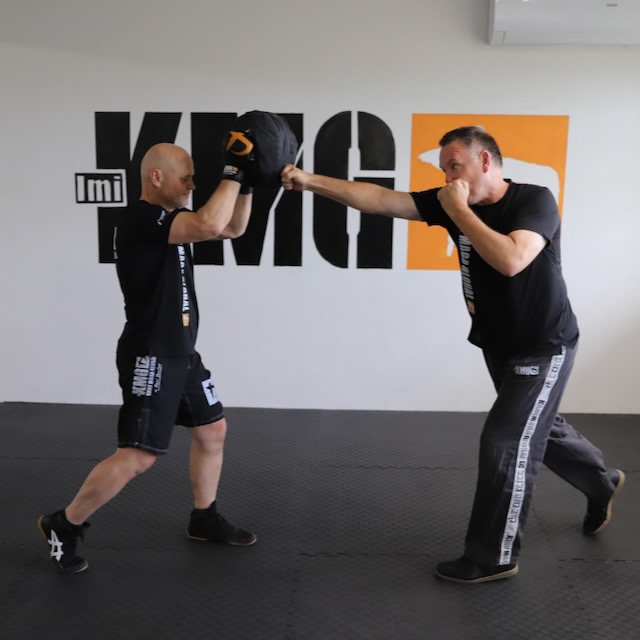
KMG striking training is built for real-world self-defence rather than ring exchange alone.
What does boxing do exceptionally well?
Boxing is a serious and highly effective striking discipline. It develops punching mechanics, footwork, distance management, timing, head movement, defensive reflexes, and the ability to perform under pressure. The point of this comparison is not to dismiss boxing — it is to recognise what problem boxing is designed to solve: a striking exchange with one opponent, under rules, inside a contained sporting environment, without grabs, kicks, takedowns, weapons, or a second attacker.
Key takeaway: boxing is an excellent striking system. The real question is whether that sporting context matches civilian self-defence.Why does context matter so much in this comparison?
Because boxing and Krav Maga are not solving the same problem. In real-world violence, the threat may involve grabs, chokes, clinch pressure, tackles, a surprise start, a weapon, or multiple people. The setting may be crowded, confined, dark, or uneven. There are no rounds, no referee, and no assumption that the other person will behave like a trained opponent.
Key takeaway: boxing is built for a controlled striking context. Krav Maga is built for civilian violence that is messy, fast, and unpredictable.What does Krav Maga train that boxing does not?
Boxing is outstanding within a narrow lane. Krav Maga is built for a wider one. The KMG curriculum trains not just the physical phase, but the wider self-defence timeline: awareness, avoidance, de-escalation, decisive action when necessary, and safe escape afterwards. Real attacks include grabs, chokes, multiple attackers, and weapons — none of which boxing addresses.
Key takeaway: boxing specialises in striking exchange. Krav Maga trains a broader self-defence framework for what happens before, during, and after the physical phase.Did Krav Maga's founder come from a boxing background?
Yes. Imi Lichtenfeld, who developed Krav Maga, was a boxer, wrestler, and gymnast. Krav Maga was created by someone who understood boxing well and then built beyond the limits of any single sport. Effective striking remains a core part of Krav Maga, but in the KMG system it sits alongside takedown defence, clinch responses, ground survival, weapon awareness, and civilian decision-making. For the wider historical context, see the origins of Krav Maga.
Key takeaway: Krav Maga was built by someone with real boxing experience, but designed to solve a broader civilian problem.Why do kicks change the range problem completely?
Boxing is a hands-only system. Krav Maga includes kicks because they create earlier interception, more distance, and another layer of disruption before an attacker can close fully. Creating distance is often more useful than winning an exchange inside it.
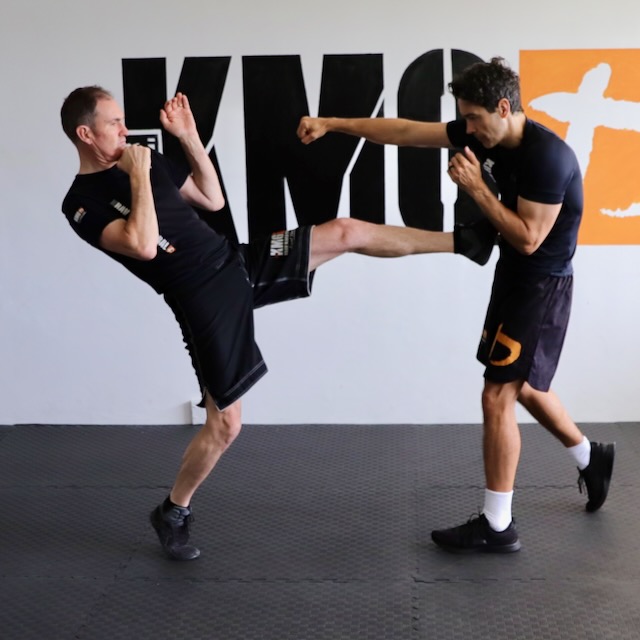
Kicks give Krav Maga a range-management option boxing does not have — distance is safety in self-defence.
Why can glove-based striking habits be a problem in real self-defence?
In real life, without gloves, punching hard into hard surfaces can easily damage the hand. Krav Maga trains bare-handed from the beginning and includes palm strikes and hammer fists that deliver force with less risk of self-injury. Training with gloves builds habits that do not always transfer cleanly to bare-handed self-defence.
Can boxing and Krav Maga complement each other?
Yes. Boxing develops sharp timing, striking confidence, distance awareness, and comfort under pressure — all of which transfer positively into Krav Maga training. The adjustment is strategic: in Krav Maga, those tools have to be integrated into a wider decision-making framework that includes grabs, weapons, multiple attackers, and safe escape.
"Very practical, realistic and highly applicable form of martial arts and self-defence system."
— Student testimonialWhy does KMG New Zealand approach this comparison from a national perspective?
KMG New Zealand is the sole national representative of Krav Maga Global (HQ), under the direct authority of Eyal Yanilov, the closest student of founder Imi Lichtenfeld. The KMG New Zealand instructor team works within that structure to keep curriculum, standards, and training logic aligned nationally.
What People Ask About Krav Maga vs Boxing
For real-world self-defence, Krav Maga is the more complete system. Boxing is excellent at one-on-one striking but does not address grabs, chokes, weapons, multiple attackers, or the wider self-defence timeline. Krav Maga is built for the broader civilian reality.
Yes. KMG training is designed for ordinary people, including complete beginners. You do not need boxing experience, martial arts experience, or competition goals to start.
Krav Maga uses straight punches and combinations that overlap with boxing, but adapts them for real-world conditions. It also includes elbows, knees, hammer fists, palm strikes, and kicks suited to managing distance and disruption in ways boxing does not cover.
Yes. Boxing can complement Krav Maga by improving timing, striking, footwork, and comfort under pressure. Krav Maga then places those assets inside a broader self-defence framework that includes grabs, weapons, multiple attackers, and safe escape.
Active KMG training is currently available in Auckland and Hastings. The national locations page at krav-maga-global.co.nz/locations connects you to the full network.
Find Training Near You
Explore the KMG New Zealand network and find the training location closest to you.
Find Training Near You