
Krav Maga vs Filipino Martial Arts — Weapons Training, New Zealand Law, and What Actually Matters for Self-Defence
Filipino Martial Arts (FMA) is a highly respected weapons system, and people drawn to it are often looking for the same thing Krav Maga offers: practical, weapons-aware self-defence. The critical difference in New Zealand is legal and tactical. FMA's traditional emphasis is on using a weapon as the primary tool, while KMG New Zealand trains weapons defence, disarming, and proportionate last-resort response within a civilian self-defence framework aligned with New Zealand law.
If you have been researching Filipino Martial Arts for self-defence, the interest makes sense. Arnis, Eskrima, and Kali have a serious reputation for practical weapons work, efficient angles, strong movement patterns, and realistic training logic. People attracted to FMA are usually asking the right questions about self-defence.
But there is a second question that matters just as much in New Zealand: how does that training translate into everyday civilian reality under New Zealand law?
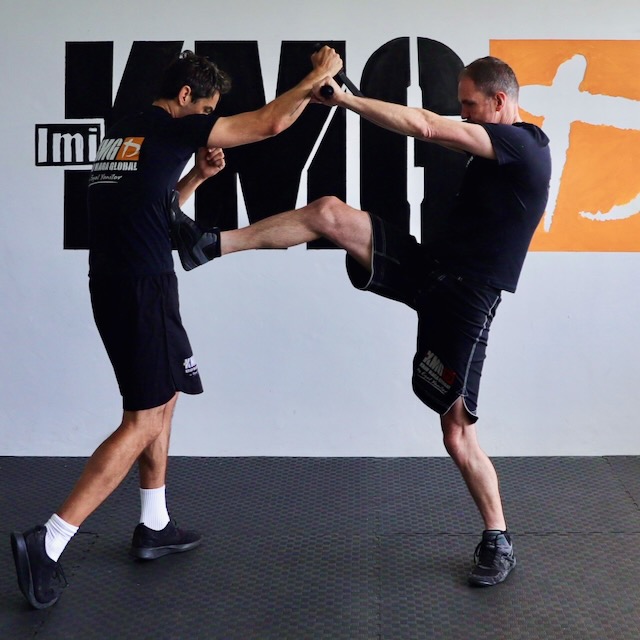
Weapon defence drilling within the KMG curriculum.
What does Filipino Martial Arts do exceptionally well?
FMA deserves genuine respect. Developed through real conflict and refined through practical use, the stick and blade mechanics in Arnis, Eskrima, and Kali are sophisticated, effective, and built on strong principles: angle recognition, weapon flow, range awareness, transitions between armed and unarmed phases, and sensitivity to movement.
People drawn to FMA are often looking for a system with a practical orientation, a clear relationship to weapons, and fewer artificial sporting constraints. Those are sensible criteria for assessing self-defence training.
The issue is not whether FMA is a serious martial art. It is. The issue is how its core emphasis fits the legal and tactical reality of civilian self-defence in New Zealand.
Key takeaway: Filipino Martial Arts is a genuinely strong weapons system. The question for New Zealand civilians is not quality, but fit.Why is the New Zealand legal context so important in this comparison?
New Zealand civilians cannot lawfully carry weapons for self-defence. That matters because any self-defence system built around weapon deployment must be judged not only by technical effectiveness, but by whether the core behaviour it assumes is lawful in everyday life. If a system's primary tool is something you cannot legally carry or use in ordinary public life, there is a serious gap between training and application.
This is the central issue in the Krav Maga vs FMA comparison in New Zealand. If your training is built around using a weapon, but carrying that weapon for self-defence is not a lawful civilian option, the training logic changes immediately.
FMA practitioners often point out, reasonably, that weapon mechanics transfer into empty-hand skill. That is true to a degree. Range, angles, timing, and awareness all carry over. But the primary orientation still matters. FMA develops strong weapon mechanics. Krav Maga develops the civilian defender who may face a weapon and needs a lawful, proportionate, practical response.
For a broader overview of how lawful and proportionate force is framed in New Zealand, the self-defence and the law article covers the civilian decision-making side in more detail.
Key takeaway: In New Zealand, self-defence training must be judged against what a civilian can lawfully and realistically do, not just what works in theory.What does Krav Maga train instead of weapon-first self-defence?
The KMG curriculum approaches weapons from the opposite direction. The starting point is not "how do I use this weapon?" but "how do I survive if someone else has one?" That leads to a very different training emphasis:
- Threat recognition and avoidance — recognising weapon cues early and creating distance before things escalate
- Weapons defence — deflecting, evading, disrupting, and responding while a weapon threat is already in play
- Disarming — removing the weapon from the attacker's control as part of a defensive sequence
- Proportionate last-resort use — understanding what is tactically and legally defensible if a weapon is acquired during the defence
This is a fundamentally different orientation. Krav Maga does not treat the weapon as the default answer. It treats the weapon as part of the threat environment and builds decision-making around survival, escape, and proportionate response.
Key takeaway: Krav Maga is weapons-aware without being weapon-dependent. The orientation is defensive first, not offensive first.Is the weapons-aware training people want from FMA already present in Krav Maga?
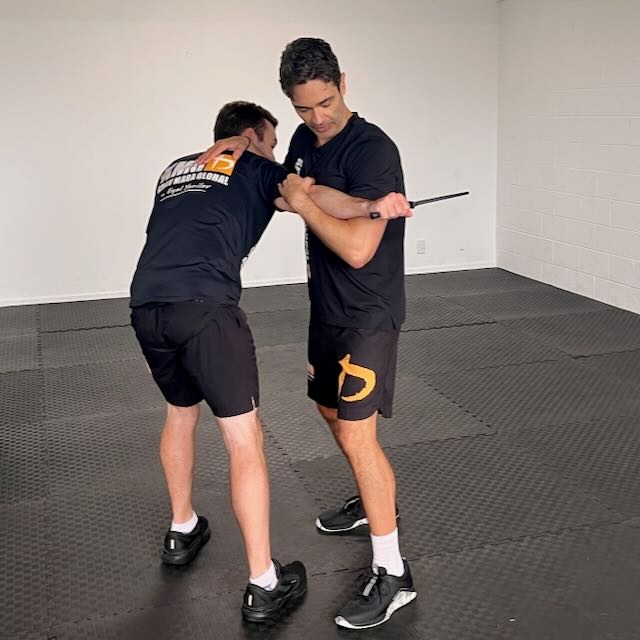
Weapons defence training within the KMG system.
If you are drawn to FMA because of its weapons focus, the KMG curriculum also addresses weapons early and seriously. Weapon awareness is not treated as an advanced curiosity. It is treated as a realistic part of the threat environment.
This is one of the strongest points in Krav Maga's favour for civilians. Many traditional systems delay weapon content for years. KMG introduces the logic of weapon threats early because the threat exists whether or not you have been training for a decade.
The difference is still orientation. FMA develops deeper specialist weapon mechanics in isolation. Krav Maga develops the broader civilian self-defence framework that includes weapons, legal context, stress response, decision-making, and escape. That makes it a more direct fit for most people starting from scratch in New Zealand.
If you are comparing systems more broadly, it also helps to read Krav Maga vs BJJ, Krav Maga vs MMA, and how Krav Maga works.
Key takeaway: If weapons awareness is what attracts you to Filipino Martial Arts, Krav Maga already addresses that need inside a broader and more civilian-relevant system.Why does Krav Maga's weapons curriculum cover so many different threats?
The breadth of Krav Maga's weapons curriculum comes from the reality in which the system was formed. It was never based on the assumption that violence would arrive in a neat or predictable way.
That lineage matters. Krav Maga descends from the experience of Imi Lichtenfeld, whose early self-defence experience involved protecting his community against real violence using improvised and conventional weapons. The result is a system built around the idea that any object in the environment can become a threat and that defence must work under messy, real-world conditions.
Key takeaway: Krav Maga's weapons curriculum is broad because real violence is broad. The system was shaped by practical necessity, not by narrow technical specialisation.What kinds of weapon threats does the KMG curriculum address?
The KMG weapons curriculum addresses a deliberately broad range of threats because civilian violence is unpredictable. That includes:
- Knives and bladed objects — including common stabbing and slashing threats
- Longer blades — where range and swing mechanics differ from short blades
- Sticks and blunt objects — including improvised impact weapons
- Flexible weapons — where motion and timing differ from rigid objects
- Thrown or improvised objects — reflecting how disorderly real attacks can be
- Firearm threats — including different positions and threat geometries
Across all of these, the KMG approach is consistent: recognise, avoid if possible, defend if necessary, disrupt decisively, and get out safely.
Key takeaway: The KMG curriculum covers a wide range of weapon threats because real attacks are varied, improvised, and unpredictable.Can Krav Maga and Filipino Martial Arts complement each other?
Yes. For someone already interested in weapons, FMA can be a useful supplement to Krav Maga. Its depth in weapon mechanics, flow, and angle awareness can sharpen understanding of how weapon attacks move and how attackers think.
The key is how you frame that training. In New Zealand, FMA is most useful when understood as a way to deepen threat awareness and movement understanding, rather than as a civilian carry-and-deploy model.
For someone starting from zero with practical civilian self-defence as the goal, KMG New Zealand is the more direct pathway. It builds the legal, tactical, and physical framework first, then integrates weapon awareness into that framework.
Key takeaway: Krav Maga and FMA can complement each other, but for most New Zealand civilians Krav Maga is the more direct and complete starting point."Excellent practical and effective self defence for ordinary people in the real world. It works for anyone regardless of gender, age or size."
— Student testimonialWhat makes KMG the national reference point for this comparison?
KMG New Zealand is the sole national representative of Krav Maga Global (HQ), operating under the direct authority of Eyal Yanilov, the closest student of founder Imi Lichtenfeld. The KMG New Zealand instructor team works within that structure to maintain curriculum consistency, instructor standards, and a civilian self-defence framework that fits New Zealand reality.
What People Ask About Krav Maga vs Filipino Martial Arts
Yes. FMA is a serious and highly respected weapons system. The question on this page is not whether it works, but whether its main orientation matches the legal and practical reality of civilian self-defence in New Zealand.
No. That is why lawful civilian self-defence training in New Zealand has to focus on awareness, avoidance, defence, escape, and proportionate response rather than a carry-and-deploy weapons model.
Yes. KMG trains recognition, defence, disruption, disarming, and escape against a wide range of threats, but the system remains grounded in civilian self-protection rather than offensive weapon use.
Yes. FMA's depth in weapon mechanics, angles, and flow can complement Krav Maga training. The key is framing FMA as a tool to deepen threat awareness rather than as a carry-and-deploy model in a civilian New Zealand context.
Active clubs are in Auckland and Hastings. Courses are building in Wellington, Hamilton, Christchurch, and other cities. The locations page has full details including waitlist registration.
Find Training Near You
Use the national locations page to find your nearest active KMG training option in New Zealand.
Find Training Near You